
Almost every garage floor quote we give starts with the same question, asked in slightly different words: can I not just paint it?
You can. People do. And in a GTA garage — road salt from November to April, a car parked on it hot off the 401, meltwater sitting in a puddle for three days — the difference between a painted slab and a coated one shows up faster here than almost anywhere else in the country.
Here is the honest comparison.
What they actually are
This is where most of the confusion starts, because the labels are close to meaningless in a hardware store.
Garage floor paint is a coloured coating, usually latex or an acrylic with a little epoxy in it, that you roll on. It sits on top of the concrete like paint on a wall. Most "1-part epoxy" kits are this. It goes on in an afternoon and it is thin — think a few thousandths of an inch, about the thickness of a sheet of paper.
A real epoxy floor is a two-part resin system. Resin and hardener are mixed on site and they cure into a solid, chemically-bonded layer many times thicker than paint. What we install is usually a build of several coats — a primer that soaks into the ground concrete, a body coat, decorative flake if you want it, and a polyaspartic topcoat over everything.
The important part is not the resin. It is what happens underneath it, which we will get to.
Durability and hot tires
This is the one that decides it for most people.
Warm tires are a chemical problem, not a weight problem. A tire that has been on the highway for forty minutes comes home soft and slightly tacky, and it sits in one spot on your floor for hours. Thin coatings soften under it, stick to the rubber, and lift off in patches when you back out. The industry term is hot-tire pickup, and it is the single most common way a painted garage floor fails.
- Floor paint: usually shows hot-tire pickup within one to two summers.
- Properly installed epoxy with a polyaspartic topcoat: rated for it and unbothered by it.
Then there is everything else a garage does. Dropped tools, a jack stand, a bike kickstand, a snowblower dragged across in February. Paint chips and scuffs. A high-build resin floor takes the hit and shows nothing.
Salt, water and our winters
A GTA garage floor spends five months a year wet with salt brine dripping off a car.
Concrete is porous. Salt water soaks in, then freezes and expands in the pores, and over years that is what spalls a slab — the flaking, pitted surface you see in older garages. Paint does not stop this because it is not a barrier; water gets under it through every pinhole and every unsealed edge.
A resin floor installed over a properly ground slab is a continuous, non-porous surface with no seams for brine to get under. That is why the floor still looks like a floor after ten winters, and it is also why the concrete under it is in better shape than it would have been bare.
Maintenance
- Paint: sweep and mop, but avoid degreasers and solvents, do not pressure wash, and expect to repaint every two to three years — which means clearing the whole garage out again.
- Epoxy: sweep, and mop when it needs it. Oil, brake fluid, antifreeze and de-icer wipe off because nothing soaks in. A pressure washer is fine.
The maintenance difference is genuinely the thing homeowners tell us they notice most, ahead of the appearance.
Lifespan
Paint is a two-to-three year decision. A proper epoxy floor is a fifteen-year-plus decision. Everything else in this comparison follows from that.
Painted floors in a daily-driven GTA garage typically need redoing every two to three years, sometimes sooner if the prep was a rinse and a rented roller. A professionally installed epoxy floor over a diamond-ground slab is a fifteen-year-plus surface, which is why our residential work carries a 15-year workmanship and adhesion warranty.
Appearance
Paint gives you a flat colour, and it shows every roller mark and every patch where the concrete drank more than the rest.
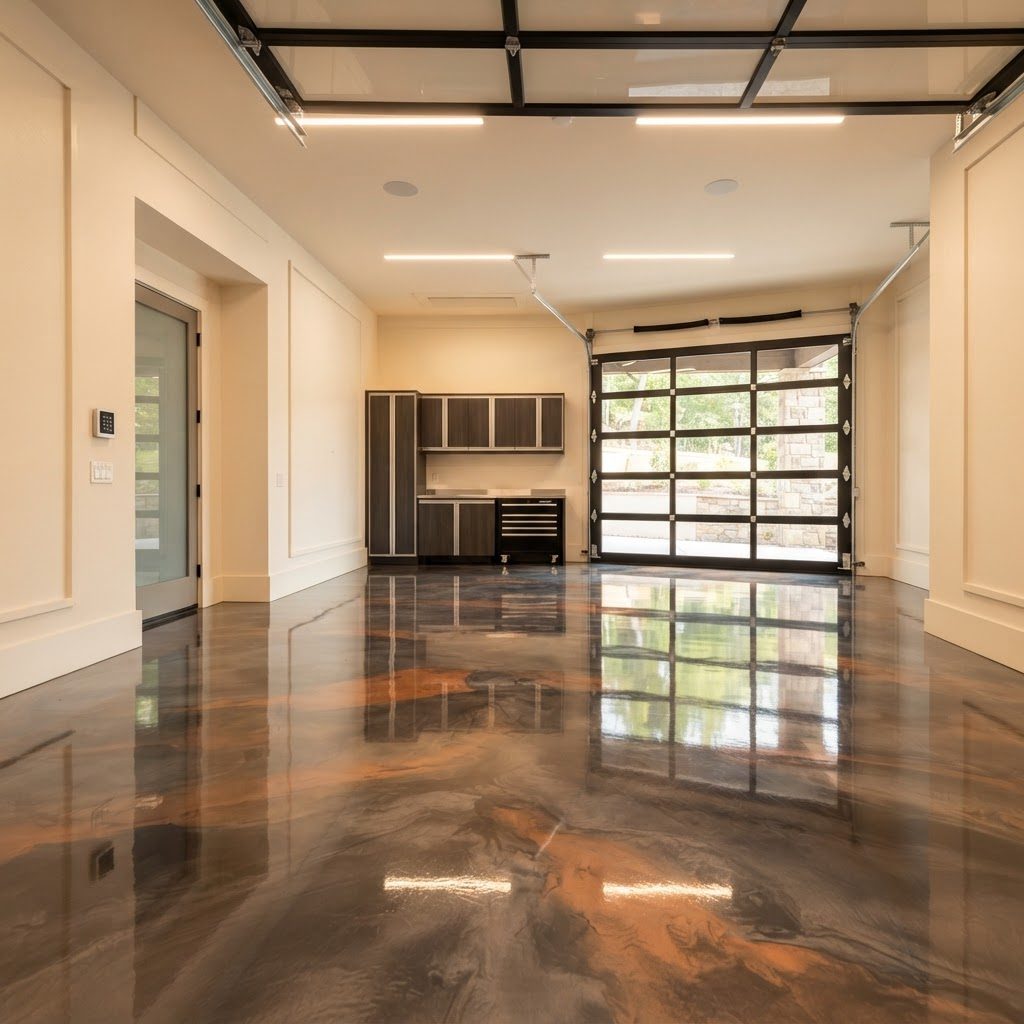
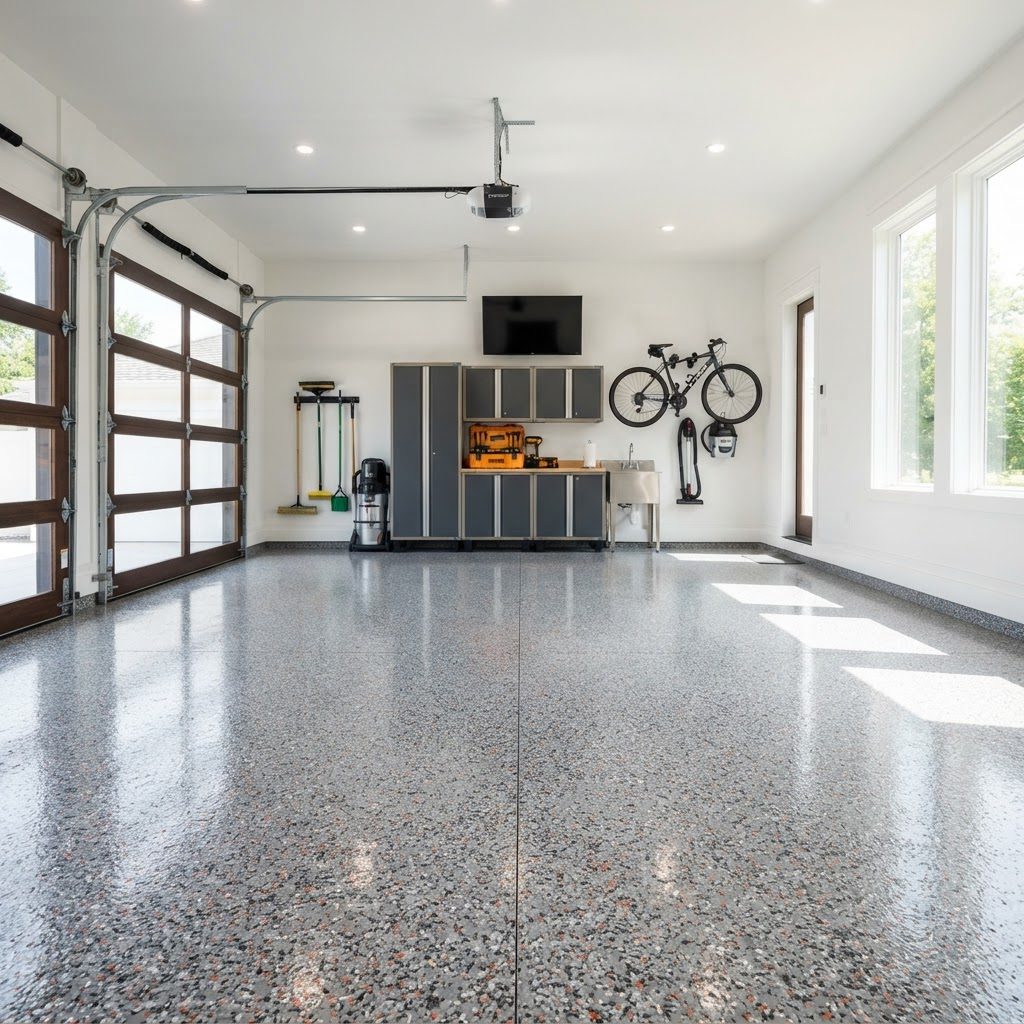
Resin systems give you a finish with depth — full flake broadcasts in whatever colour blend you like, metallic pours that move like stone, or a clean solid colour with a satin or high-gloss topcoat. It also reflects light, which makes a difference in a garage with one small window: people are consistently surprised at how much brighter the space feels.
The cost, honestly
Paint is cheaper on day one. That is the entire case for it, and it is a real one.
- DIY paint or a big-box kit: roughly $2–$3 per square foot in materials, plus your weekend.
- Professional epoxy in the GTA: roughly $4–$9 per square foot depending on the system, the condition of the slab and the finish.
But run it over ten years in a real garage. Paint at two-and-a-half-year intervals is four applications — four weekends, four times emptying the garage, four rounds of materials, and a slab that has been quietly absorbing salt the whole time. The epoxy floor is still on its first install, still under warranty, and the concrete beneath it has been protected the entire time.
We break the pricing down properly in our GTA cost guide.
When paint is genuinely the right call
We would rather say this than sell you something you do not need:
- A garage you are selling in under a year and only want to tidy up.
- A shed or an outbuilding that never sees a vehicle.
- A slab so badly spalled it needs resurfacing first and the budget is not there this season.
Everywhere else, on a floor you park on, paint is a deferral rather than a solution.
The part that decides it either way
Here is what neither product's label tells you: the coating is not what fails. The bond is.
A hardware-store kit that says to etch with acid, and an installer who shows up with a pressure washer instead of a grinder, are both making the same mistake — the concrete has not been opened up, so nothing can key into it. It is why cheap epoxy jobs peel too.
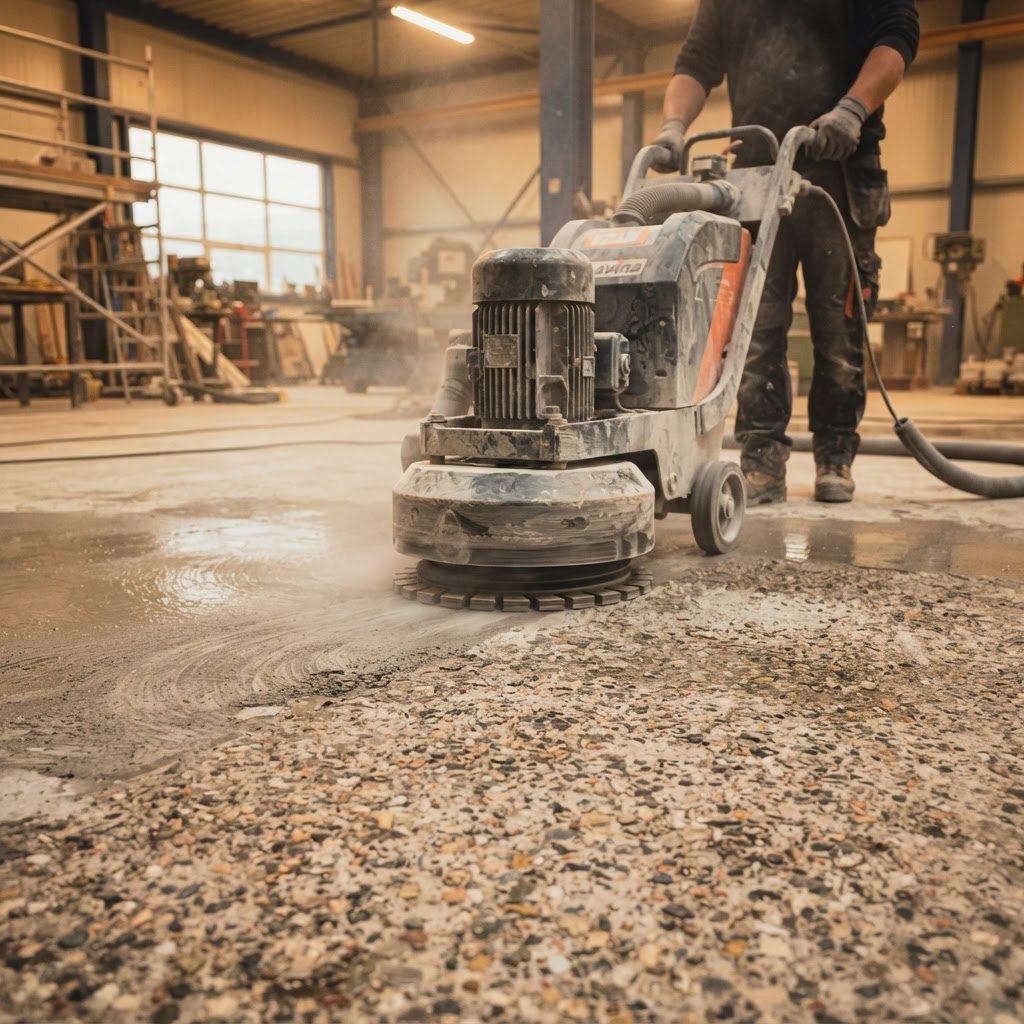
We diamond-grind every slab to a proper surface profile, chase and fill the cracks, and moisture-test before a drop of resin goes down. That is where a floor is won or lost, and it is the subject of its own article.
Thinking about it for your garage? Send us a photo of the slab and the rough dimensions, and we will tell you honestly what it needs — including if that is less than you thought.