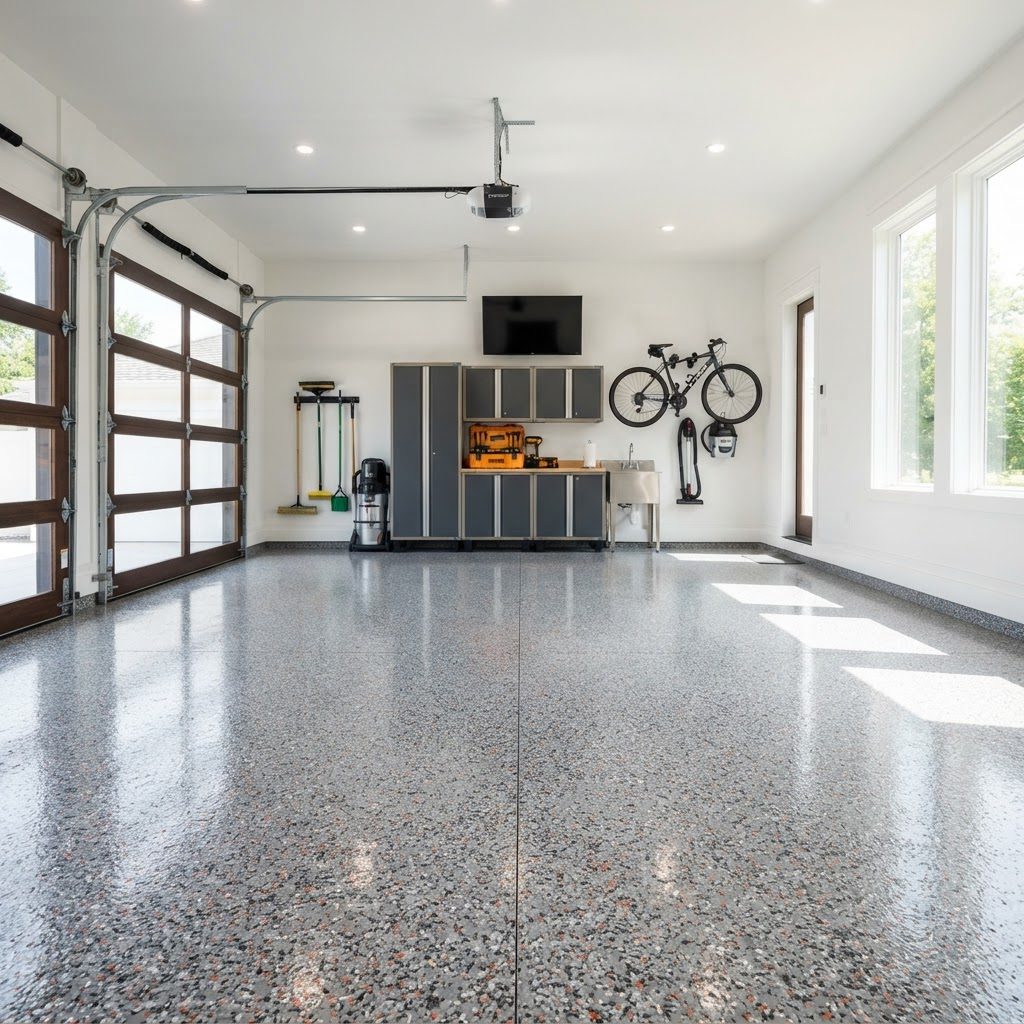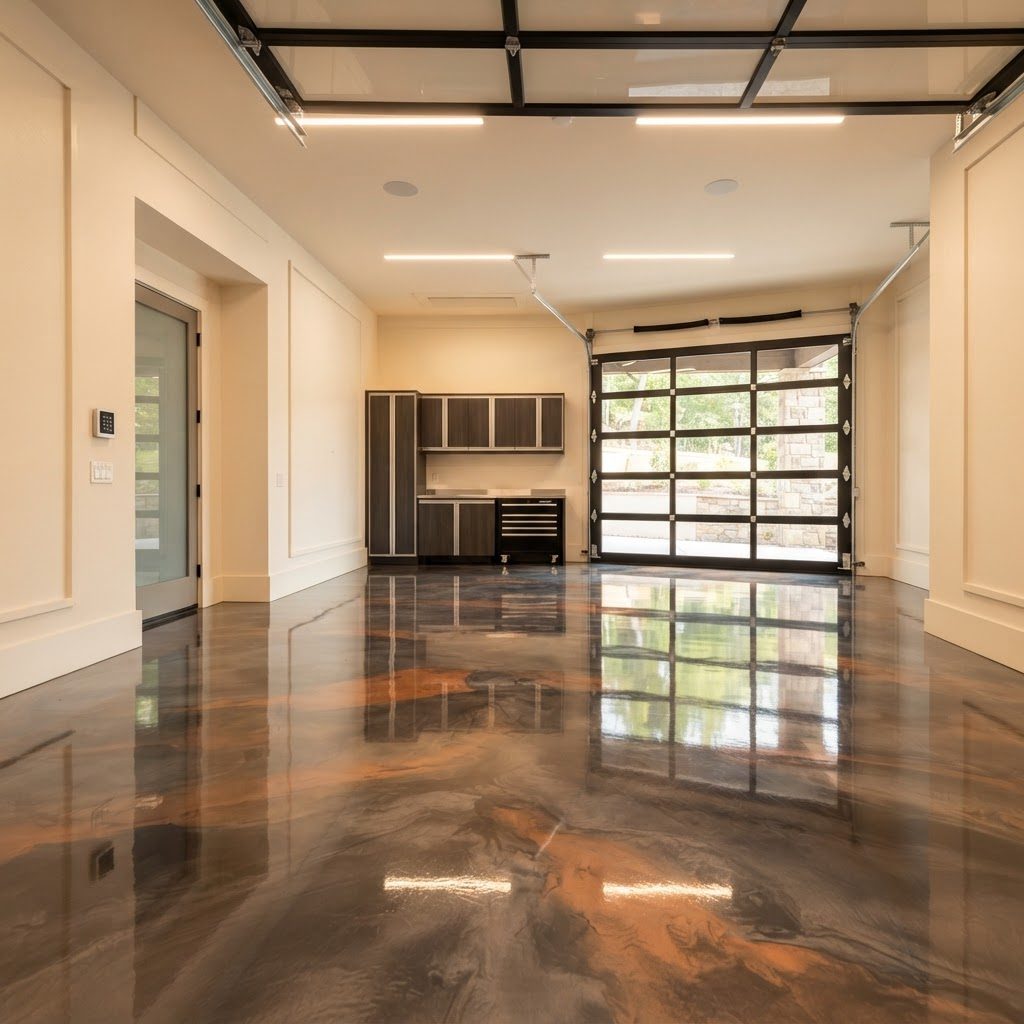

We have been called out to look at a lot of failed epoxy floors. Peeling in sheets near the door, lifting in circles where the car parks, bubbling in patches across the middle.
In almost every one of those cases the resin was fine. It had cured properly, it was the right product, and if you picked up a lifted piece it was still hard and intact. It just was not attached to anything.
That is the whole subject of this article. A resin floor is a bond, not a coating, and the bond is made in the concrete — before any product comes out of a pail.
Concrete does not want to be coated
A garage slab in the GTA has usually been power-troweled: finished with a spinning steel blade that burnishes the top into a dense, closed, slightly glassy skin. It is a good surface to have. It is also almost entirely non-absorbent, which is exactly wrong for adhesion.
Pour resin onto that skin and it sits on it, held by nothing but surface tension. It looks perfect. It will peel.
On top of that skin, most slabs also carry:
- Curing compounds sprayed on when the concrete was poured, specifically designed to stop things penetrating.
- Efflorescence — mineral salts pushed up from below over years.
- Oil and grease, driven deep into the pores under a hot engine.
- Old sealers, often applied by a previous owner and long forgotten.
None of that is visible on a swept floor. All of it is a bond breaker.
Diamond grinding: what it is and why nothing else does it
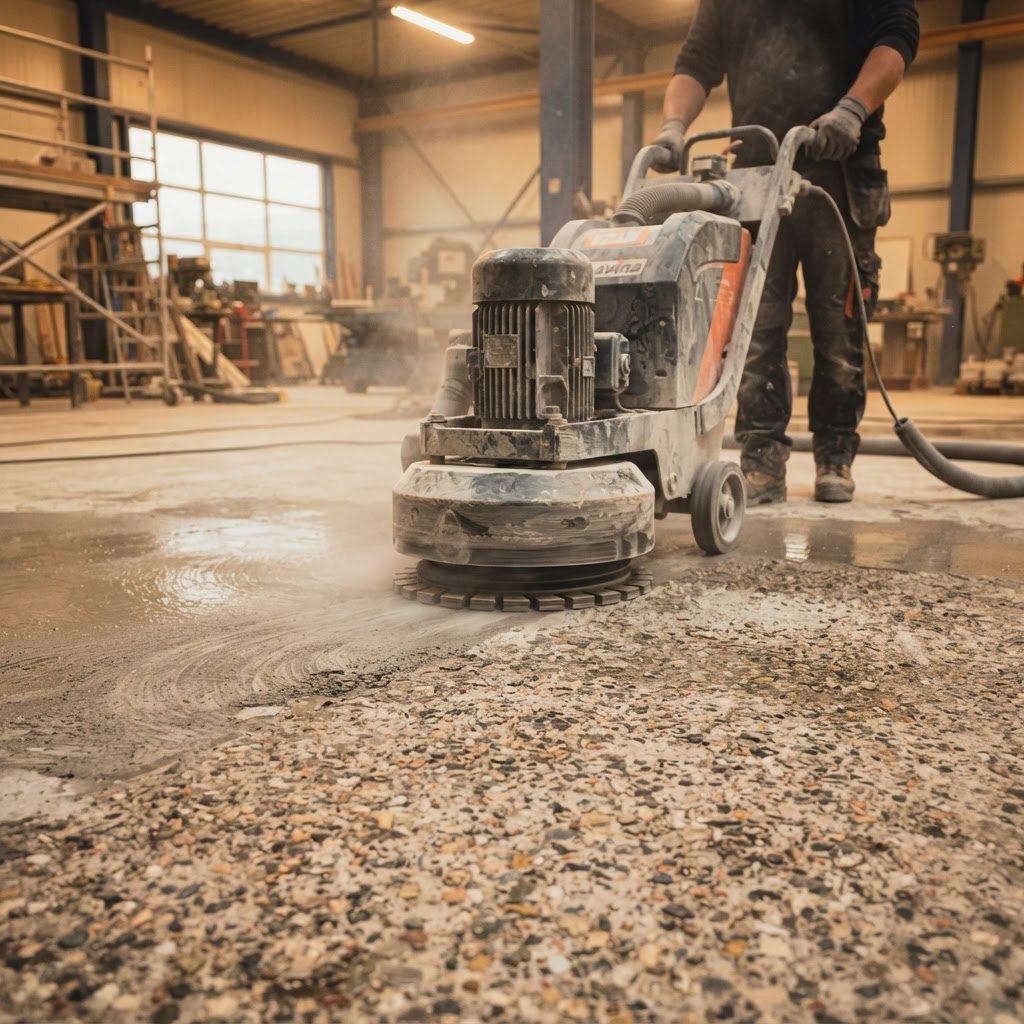
We diamond-grind every floor. A weighted machine runs diamond-segment tooling across the slab under vacuum, and it does two things at once:
1. Removes the troweled skin, the curing compound, the sealers, and the contaminated top layer.
2. Opens the concrete to a measurable surface profile — a controlled roughness the resin flows into and locks against mechanically.
The industry measures that roughness on the CSP scale (Concrete Surface Profile), and every coating system specifies the profile it needs. This is not a matter of opinion; the manufacturer's own datasheet states it, and a warranty claim is refused without it.
What acid etching does not do
Acid etching is what the box kits tell you to do, and it is the most common shortcut on a cheap quote.
Muriatic acid attacks the cement paste, and on a soft, open, broom-finished slab it can produce something. On a power-troweled garage floor it typically produces an uneven, partially-etched surface that fails to reach profile in the dense areas — which are precisely the areas where the bond needs to be strongest. It also leaves salts behind that have to be neutralised and rinsed, and the rinse water goes somewhere.
Pressure washing is worse still: it cleans the surface without opening it at all, and it drives water into the slab that then has to come back out through your new floor.
Grinding is more expensive because it is a machine, a crew and dust containment. That cost is the floor.
Cracks, joints and spalling
Grinding gets you a surface. It does not fix a slab.
- Cracks are chased out — cut open into a V — so the repair compound has something to grip, then filled with a rigid structural filler and ground flush. Filling a hairline crack without opening it just puts material in a groove; it pops out within a year and reappears through the coating.
- Control joints are a decision, not an oversight. They are usually filled with a semi-rigid joint filler and coated over on residential floors, but a joint that is actively moving has to be honoured rather than bridged, or the floor will crack in exactly the same line.
- Spalled and pitted areas — the flaking, pockmarked concrete our winters produce — are patched with a repair mortar, or resurfaced entirely when the damage is widespread. A resin coat over spalled concrete is a gloss finish on a failing surface, and it fails with it.
- Pinholes and bug holes get filled at the primer stage, because air trapped in them expands as the slab warms and pushes blisters up through a curing coat.
Moisture: the failure nobody sees coming
This is the one that catches people, and it is the one most often skipped.
Concrete on grade is in contact with the ground, and ground moisture moves upward through it as vapour continuously. If that vapour reaches a sealed, non-breathable coating, it builds pressure underneath and eventually pushes the coating off the slab. Perfect resin, perfect grinding, floor lifts anyway.
It matters especially in:
- Basements, always.
- Garages built on a slab with no vapour barrier, which is much of the GTA's older housing stock.
- Anywhere with a high water table, or a slab that has always looked damp in one corner.
Testing is straightforward — a calcium chloride test or a relative humidity probe, run before we schedule the install. Where the reading is high, we install a moisture-mitigating primer designed to take the vapour pressure. It costs a little more. It is the difference between a floor and a warranty claim.
Coating thickness — the other invisible half
Once the slab is right, how much material goes on it decides how long it lasts.
A garage floor kit rolls on at a few mils — thousandths of an inch. What we install is a system, built up in layers:
- A penetrating primer that soaks into the freshly ground concrete and grips it.
- A body coat carrying the colour or the flake.
- Decorative flake, broadcast to refusal where that finish is chosen.
- A polyaspartic topcoat — UV-stable so it does not yellow, fast-curing, and the layer that actually handles hot tires, salt and abrasion.
The result is many times the thickness of a rolled coating, and thickness is what absorbs impact and wear rather than transmitting it straight to the bond line.
What proper prep looks like on the day
On a typical residential install:
- The floor is cleared and any oil is degreased and treated.
- We diamond-grind wall to wall under vacuum. Containment goes up; there is dust equipment running the whole time, not a shop broom afterwards.
- Cracks are chased and filled, spalls patched, joints treated, and everything ground flush.
- The slab is vacuumed to a state most people describe as cleaner than their kitchen floor.
- Moisture readings are confirmed.
- Primer goes down onto concrete that was ground that same day — profile does not keep, and a slab left open overnight picks up dust and humidity.
- Coats follow in their recoat windows, which the products dictate and the weather affects.
Most single and double garages are a one-day install with a fast-cure polyaspartic top. Walk on it the same evening; park on it in 24–48 hours.
What this actually buys you
A properly prepared floor is why we can put a 15-year workmanship and adhesion warranty on residential work and mean it. Adhesion is the word doing the work in that sentence — it is the failure that prep prevents, and it is the one most warranties quietly exclude.
If you take one thing from this: when you are comparing quotes, do not compare the resin. Ask each installer how they will prepare your slab, and ask them to put the answer in writing.
Want to know what your floor needs? Send us a photo and the rough dimensions. We will tell you honestly what state the slab is in — including when the answer is that it needs less than you feared.